Ideal Solution
Prelude
from landau.phases import LinePhase, IdealSolution
from landau.calculate import calc_phase_diagram
from landau.plot import plot_phase_diagram, plot_1d_T_phase_diagram, plot_1d_mu_phase_diagram, plot_mu_phase_diagram
import numpy as np
from scipy.constants import Boltzmann, eV
kB = Boltzmann/eV
import seaborn as sns
import matplotlib.pyplot as plt
Phases Setup
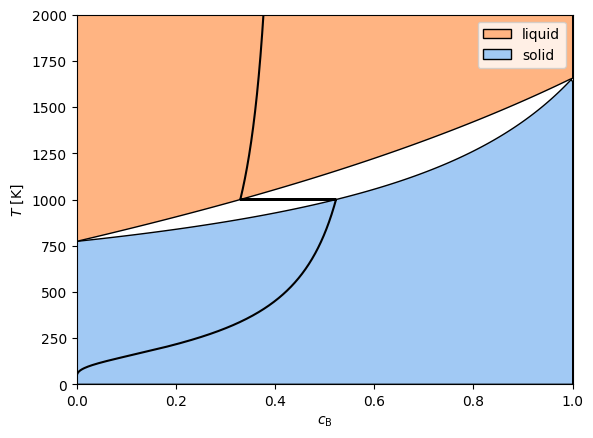
Set up some simple toy phase models that yields this phase diagram.

solid_a = LinePhase('A', fixed_concentration=0, line_energy=-2.0, line_entropy=1.0*kB)
solid_b = LinePhase('B', fixed_concentration=1, line_energy=-3.0, line_entropy=1.5*kB)
solid = IdealSolution('solid', solid_a, solid_b)
liquid_a = LinePhase('A(l)', fixed_concentration=0, line_energy=-1.9, line_entropy=2.5*kB)
liquid_b = LinePhase('B(l)', fixed_concentration=1, line_energy=-2.9, line_entropy=2.2*kB)
liquid = IdealSolution('liquid', liquid_a, liquid_b)
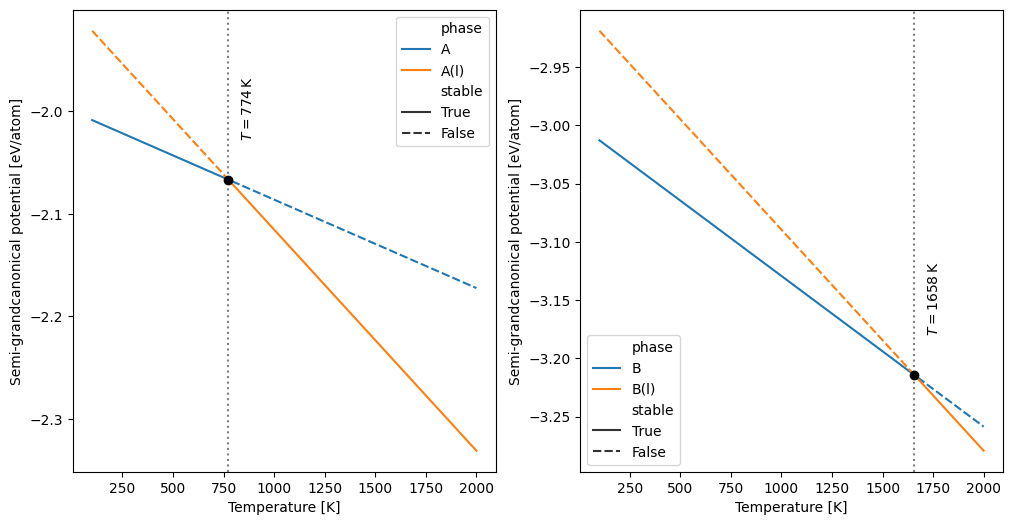
Examples for congruent melting
For the terminals and at fixed concentration, the chemical potential difference does not matter, so we can set it to zero. In this case the semigrand potential is equal to the free energy.
plt.figure(figsize=(12,6))
plt.subplot(121)
df = calc_phase_diagram([solid_a, liquid_a], Ts=np.linspace(100, 2000, 100), mu=0.0, keep_unstable=True)
plot_1d_T_phase_diagram(df, ax=plt.gca(), show=False)

plt.subplot(122)
df = calc_phase_diagram([solid_b, liquid_b], Ts=np.linspace(100, 2000, 100), mu=0.0, keep_unstable=True)
plot_1d_T_phase_diagram(df, ax=plt.gca(), show=False)
<Axes: xlabel='Temperature [K]', ylabel='Semi-grandcanonical potential [eV/atom]'>
Non-Congruent Melting
However, the general formulation in the semigrand ensemble allows us to also investigate non-congruent melting transitions using the exact same code and formalism.

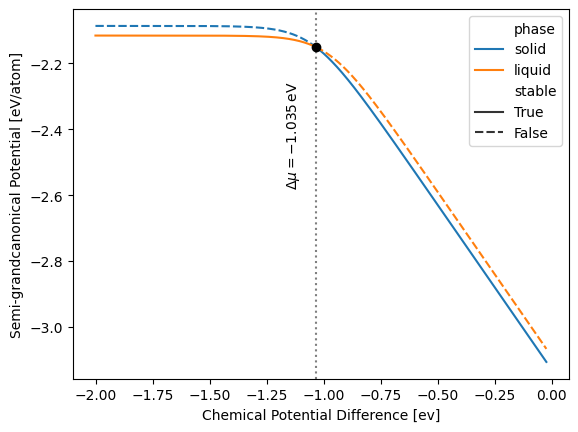
To do this, let’s first find out, what’s the chemical potential difference where liquid and solid are in equilibrium at, say, 1000K.

T_twophase = 1000
df = calc_phase_diagram([solid, liquid], Ts=T_twophase, mu=1000, keep_unstable=True)
plot_1d_mu_phase_diagram(df)
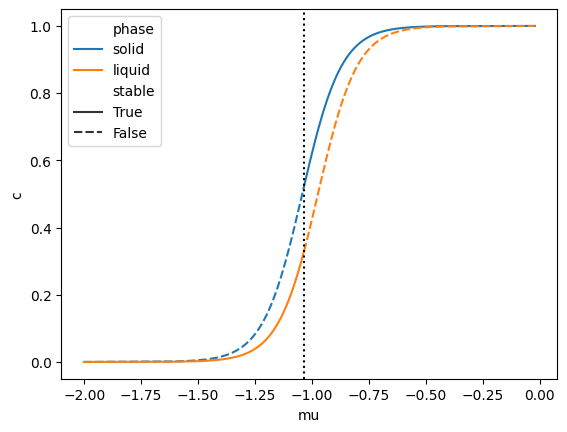
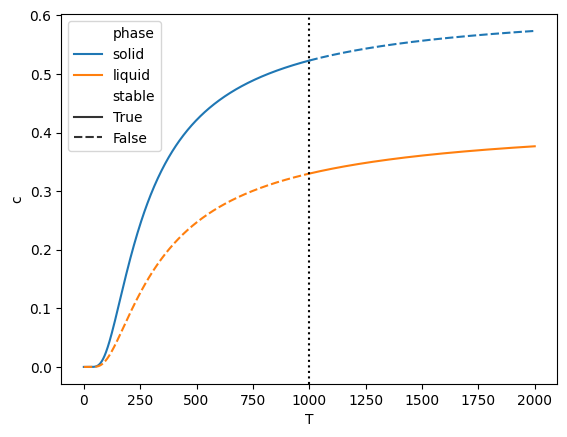
From the results, we can already get the concentrations on the liquidus and solidus, either by plot isotherms or numerically from the dataframe.
df.query('border')
| T | phase | phi | mu | c | stable | border | refined | f | f_excess | |
|---|---|---|---|---|---|---|---|---|---|---|
| 2000 | 1000 | liquid | -2.149932 | -1.035211 | 0.329906 | True | True | mu | -2.491454 | -0.041544 |
| 2001 | 1000 | solid | -2.149932 | -1.035211 | 0.522831 | True | True | mu | -2.691173 | -0.045672 |
mu_equilibrium_1000k = df.query('border').mu.iloc[0] # ~ -1.035 eV
mu_equilibrium_1000k
np.float64(-1.0352114196607491)
sns.lineplot(
    data=df,
    x='mu', y='c',
    hue='phase',
    style='stable', style_order=[True, False],
)
plt.axvline(mu_equilibrium_1000k, ls='dotted', c='k')
<matplotlib.lines.Line2D at 0x7f5e2bb7ea10>
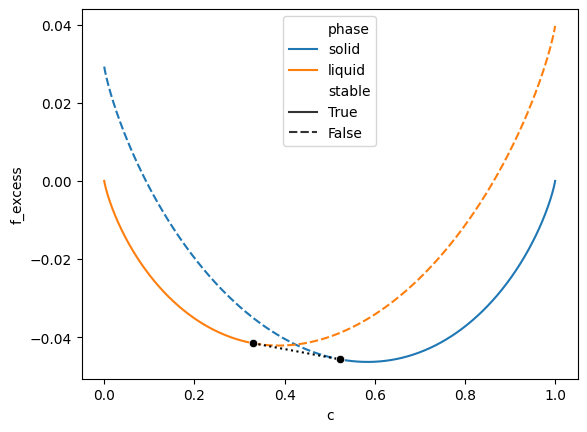
Using the f and f_excess columns, we can also plot the more familiar common tangent construction.
sns.lineplot(
    data=df,
    x='c', y='f',
    hue='phase',
    style='stable', style_order=[True, False]
)
sns.lineplot(
    data=df.query('border'),
    x='c', y='f',
    ls='dotted', c='k'
)
sns.scatterplot(
    data=df.query('border'),
    x='c', y='f',
    c='k',
    zorder=2
)
<Axes: xlabel='c', ylabel='f'>
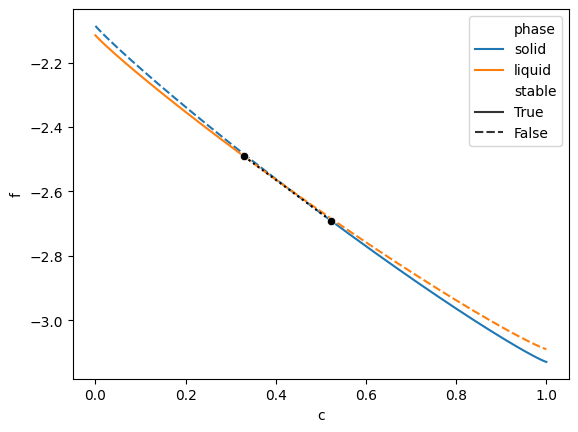
Difficult to see in \(f\) due to linear shift, let’s use \(f_\mathrm{excess}\) to see it more clearly.
sns.lineplot(
    data=df,
    x='c', y='f_excess',
    hue='phase',
    style='stable', style_order=[True, False]
)
sns.lineplot(
    data=df.query('border'),
    x='c', y='f_excess',
    ls='dotted', c='k'
)
sns.scatterplot(
    data=df.query('border'),
    x='c', y='f_excess',
    c='k',
    zorder=2
)
<Axes: xlabel='c', ylabel='f_excess'>
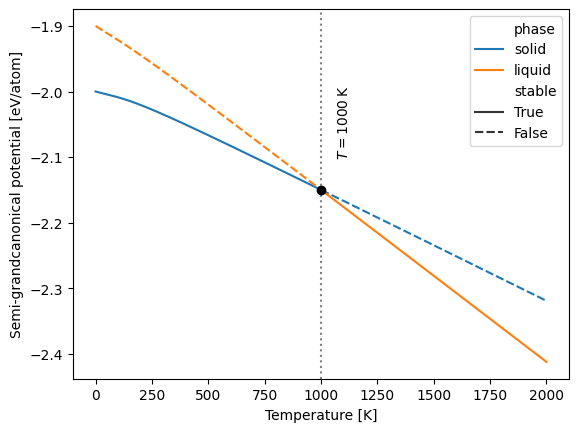
df = calc_phase_diagram([solid, liquid], Ts=np.linspace(0, 2000, 1000), mu=mu_equilibrium_1000k, keep_unstable=True, refine=True)
plot_1d_T_phase_diagram(df)
<Axes: xlabel='Temperature [K]', ylabel='Semi-grandcanonical potential [eV/atom]'>
sns.lineplot(
    data=df,
    x='T', y='c',
    hue='phase',
    style='stable', style_order=[True, False],
)
plt.axvline(T_twophase, ls='dotted', c='k')
<matplotlib.lines.Line2D at 0x7f5e2a019a90>
Appendix: Inline Plots
Code that generates the pasted pictures above.
bdf = calc_phase_diagram([solid, liquid], Ts=np.linspace(0, 2000, 100), mu=200, keep_unstable=True)
Fig1
plt.figure(figsize=(12,6))
plt.subplot(121)
plot_phase_diagram(bdf, element='B', poly_method='fasttsp')
plt.subplot(122)
plot_mu_phase_diagram(bdf, element='B', poly_method='fasttsp')
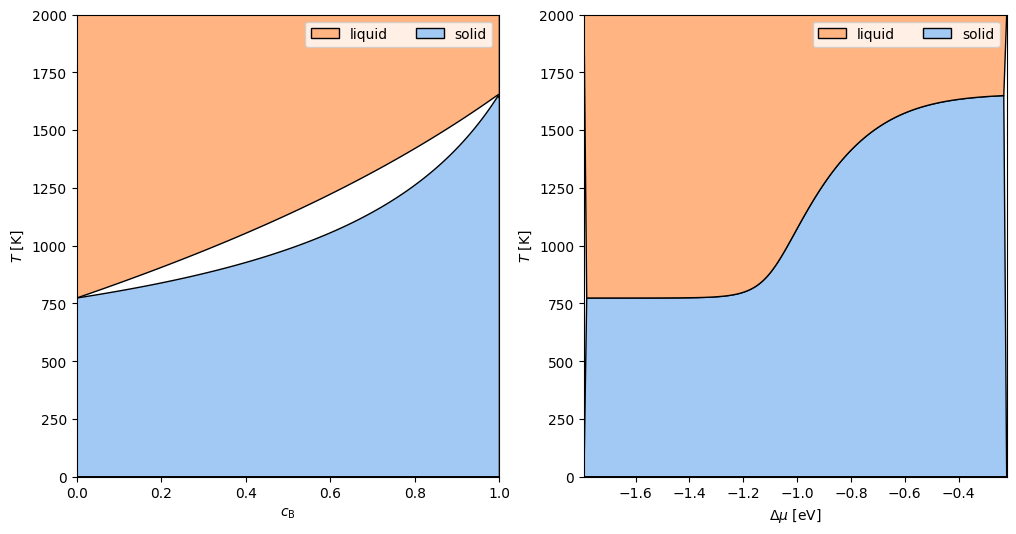
Fig3
T_twophase = 1000
df1000 = calc_phase_diagram([solid, liquid], Ts=1000, mu=1000, keep_unstable=True)
mu_equilibrium_1000k = df.query('border').mu.iloc[0]
plot_phase_diagram(bdf, element='B', poly_method='fasttsp')
plt.axhline(1000, ls='-', c='k')
sns.scatterplot(
    data=df1000.query('border'),
    x='c', y='T',
    marker='o', c='k'
)
<Axes: xlabel='$c_\\mathrm{B}$', ylabel='$T$ [K]'>
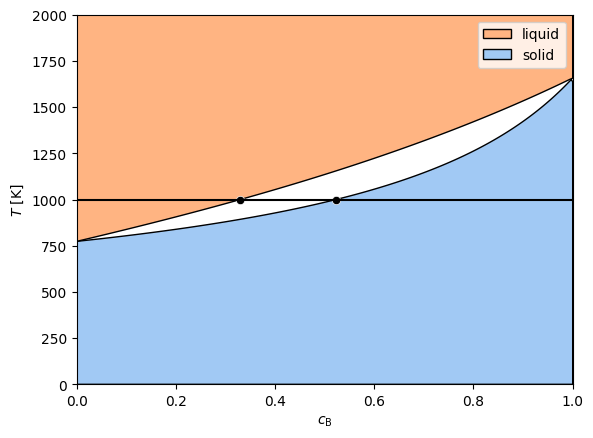
Fig2
dfisomu = calc_phase_diagram([solid, liquid], Ts=np.linspace(0, 2000, 1000), mu=mu_equilibrium_1000k, keep_unstable=True, refine=True)
plot_phase_diagram(bdf, element='B', poly_method='fasttsp')
sns.lineplot(
    data=dfisomu.query('stable'),
    x='c', y='T',
    orient='y',
    # sort=False,
    estimator=None,
    c='k'
)
<Axes: xlabel='$c_\\mathrm{B}$', ylabel='$T$ [K]'>